
Work Zone Safety
In 2025, 60% of highway construction firms had a vehicle crash into their work zone.
Drivers, passengers, and workers all share that risk. Active Worksite™ is built to lower it.
Active Worksite warns drivers in real time when they're approaching your crew on the road. It uses the navigation tools they already have. No new hardware on the truck. No app for the driver to install.
Protect Your People TodaySource: 2025 AGC/HCSS Highway Workzone Study
Focused on the worker
The goal isn't zero machine hits. It's zero deaths.
Smart arrow board signs, lane closure warnings, connected equipment, and more are part of the industry's methods for generating active work zone alerts.
Every DOT across the country aims for zero fatalities, not just zero incidents. It's the worker who has to come home safe at the end of their shift.
That's where Active Worksite lives. It doesn't track signs, cones, or machines. It tracks the people doing the work and warns drivers in real time when they're nearby. Object-tracking systems do important work in their lane. Worker-tracking is the critical layer required for the zero-fatality goal.
Protecting the worker protects everyone.In 2025, 22% of highway construction firms reported a driver or passenger fatality, roughly three times the rate reporting a worker fatality (7%). When drivers know a real crew is working, they slow down. Both the people on the road and the people in the cars come out safer.
Source: 2025 AGC/HCSS Highway Workzone StudyWhere Active Worksite protects you
Three places your people are at risk. Drivers are warned in all three.
The defined work zone is the common case. The other two extend the same protection to situations without an engineered plan.
Inside a defined work zone
Drivers know where work is actually happening within a work zone.
Many work zones are miles long with spots of activity within the zone. When drivers enter a work zone and don't see activity, they quickly tone out and increase speed. Active Worksite throws alerts when workers are upcoming.
Bonus Benefit
OnStation knows the start and end points of the engineered project. The whole work zone goes "active" the moment a worker on the project turns on Active Worksite.
On an undefined worksite
Crews get seen, even when there's no closure on the map.
Utility crews working off the shoulder. Maintenance teams patching outside a formal closure. Milling, sealing, striping without an engineered work zone. When a worker turns on Active Worksite, drivers get the same real-time alert, whether or not there's a closure on the map.
Outside any work zone
Where there's no zone at all, there's still a worker to protect.
Surveyors taking measurements on an active road. Maintenance vehicles stopped on a shoulder. Inspectors walking a corridor between projects. Active Worksite alerts drivers to a worker anywhere they're exposed to live traffic, work zone or not.
How it works
Four steps from your phone to a driver's screen.
The worker does the first two steps. The system handles the other two.
Open OnStation on your phone.
Download the app and sign in. About five minutes if it's your first time. If your organization has Active Worksite and you are within a defined project, the system automatically turns on. You can skip step two.
Turn on the Active Worksite shield.
One tap. The shield stays on while you're working and auto-shuts off after 30 minutes to prevent positions from being broadcast when no one is on the road. If your location changes within those 30 minutes, the shield remains on.
Your position publishes in real time.
OnStation sends your live position (through our integrator iCone) to the federal Work Zone Data Exchange, the data feed that powers driver-side navigation alerts.
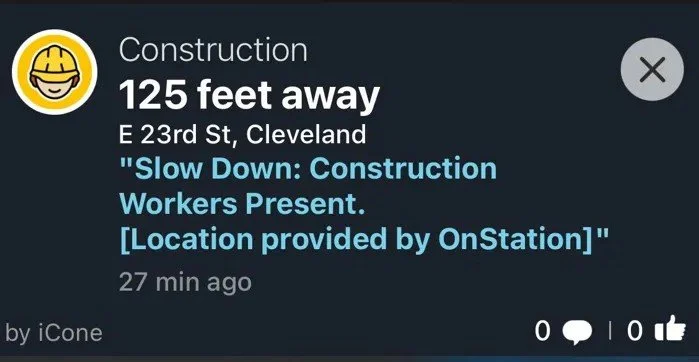
Drivers nearby see "Workers Ahead."
Drivers in Waze, automotive OEM navigation, and automated driving systems see the alert automatically as they approach your live position.
Driver alerts trigger when traffic is within 130 ft of the worker centerline.
The federal data layer
The alert system drivers already have.
Active Worksite publishes to the Work Zone Data Exchange, the federal standard the major navigation apps already consume.
PART 1
What WZDX is.
The Work Zone Data Exchange (WZDX) is the federal standard for work zone data, co-led by the Federal Highway Administration and the Intelligent Transportation Systems Joint Program Office. Any navigation app, automotive OEM, or automated driving system can consume it. More than 25 state DOTs already publish to it.
PART 2
What OnStation contributes.
Active Worksite feeds two layers into WZDX that rarely appear together.
Layer 1 (In-Development)
Engineered project boundaries
Sourced from CAD during project submission. OnStation knows the precise start and end of every defined project.
Layer 2
Real-time worker presence
Sourced from the Active Worksite shield on a worker's phone. Live, not scheduled.

Most WZDX feeds today describe where work is planned. Active Worksite describes where work is actually happening, right now, inside the engineered span.
PART 3
Where it goes.
Your crew flips the shield. The federal data layer does the rest.
Your crew
Shield on
OnStation
Routed via iCone
WZDX
Waze, OEMs, ADS
Drivers
"Workers Ahead"
No app-by-app integration. No new hardware. No DOT permission required for the contractor to be the data source.
Where federal policy is heading
Federal direction is moving toward exactly this.
The currently proposed BUILD America 250 Act points federal safety funding and policy directly at digital alerting and roadway worker protection.
Section 1117
Adds digital alerting systems to the Highway Safety Improvement Program (HSIP).
Section 4002
Names work zone driver awareness, digital alert technology, and safety for vehicles stopped at the roadside as eligible under Section 402 highway safety grants.
Section 4009
Creates an FHWA, NHTSA, and OSHA interagency working group on roadway worker protection.
OnStation already feeds the federal data standard these sections point toward.
Pricing
One price for contractors. One contact for agencies.
Active Worksite is priced to drive coverage and worker protection. More crews using it means safer roads.
Contractors & CEI Firms
$3,500
per year, per organization
Add-on for organizations with an active OnStation account. Covers every licensed user on the team. No per-seat math, no usage caps.
Starts with a 7-day access period. Pay only if you decide to keep it.
DOTs, Agencies, Municipalities
Talk to Ward.
Active Worksite is available as a standalone product for agencies. No full OnStation package required, and pricing scales to the size of your state or jurisdiction.
Start with Active Worksite. Add the rest of OnStation when you're ready.
From the field
Active Worksite has given our crews a stronger sense of security.
Too often, drivers become accustomed to work zones that remain set up even when no one is on site. This feature helps break that habit. It reminds the traveling public to stay alert and cautious whenever they see that crews are actively working, often just feet from live traffic.
Mark Allegri
Project Manager, Ideker, Inc.
Real questions about Active Worksite
Seven questions we hear most.
From contractors, CEI firms, and agencies in sales calls. Straight answers.
What is Active Worksite?
Active Worksite is OnStation's worker-focused work zone safety system. When a worker turns on the shield in the OnStation app, their live position publishes to the federal Work Zone Data Exchange (WZDX). Waze, automotive OEM navigation, and automated driving systems pull from that feed and warn drivers approaching the worker.
Does it require extra hardware?
No. Active Worksite runs on the smartphone a worker already carries. No hardware on the truck, no devices on the crew. Drivers don't need to install anything either. Alerts surface in the navigation apps they already use.
Does it require DOT approval to deploy?
No. WZDX is an open federal data standard. A contractor or CEI firm can be a producer without state DOT permission. State DOTs can also participate, but they aren't gatekeepers for contractor-side data.
How is this different from cones, signs, or work zone systems we already use?
Most work zone safety technology uses objects: cones, signs, machines, and telematics to generate an active work zone alert. Active Worksite tracks the worker. When the goal is zero fatalities, the worker is the one who needs protection. Active Worksite sits alongside existing object-tracking systems, not as a replacement.
How does the alert reach drivers?
OnStation publishes your live worker position to the Work Zone Data Exchange (WZDX), the federal standard for work zone data. Waze, automotive OEM navigation, and automated driving systems already consume that feed. When a driver approaches an active worker, they see "Workers Ahead" in whichever navigation tool they're using. Driver alerts trigger when traffic is within 130 ft of the worker centerline.
Is worker location data private?
Worker positions are transmitted only while the Active Worksite shield is on, and only while a worker is within 130 ft of a project centerline. The shield auto-shuts off after 30 minutes so positions don't broadcast when no one is on the road. The WZDX feed publishes a generic "Workers Ahead" alert, not personal identifiers. Drivers don't see who specifically is on the road.
OnStation is SOC 2 Type II certified.
What does it cost, and how do I start?
For contractors and CEI firms with an active OnStation account, Active Worksite is a $3,500 per year add-on covering every licensed user on the team. It starts with a 7-day access period. Pay only if you decide to keep it.
DOTs, agencies, and municipalities can purchase Active Worksite as a standalone product. Contact Ward Zerbe, Director of Public Sector, to talk pricing.
Protect Your People Today.
The shield is one tap away.
OnStation by the numbers
4
DOTs actively using Active Worksite
20
DOT footprint nationwide
95%
customer retention
5,000+
projects on OnStation
500+
organizations
SOC 2
Type II Certified